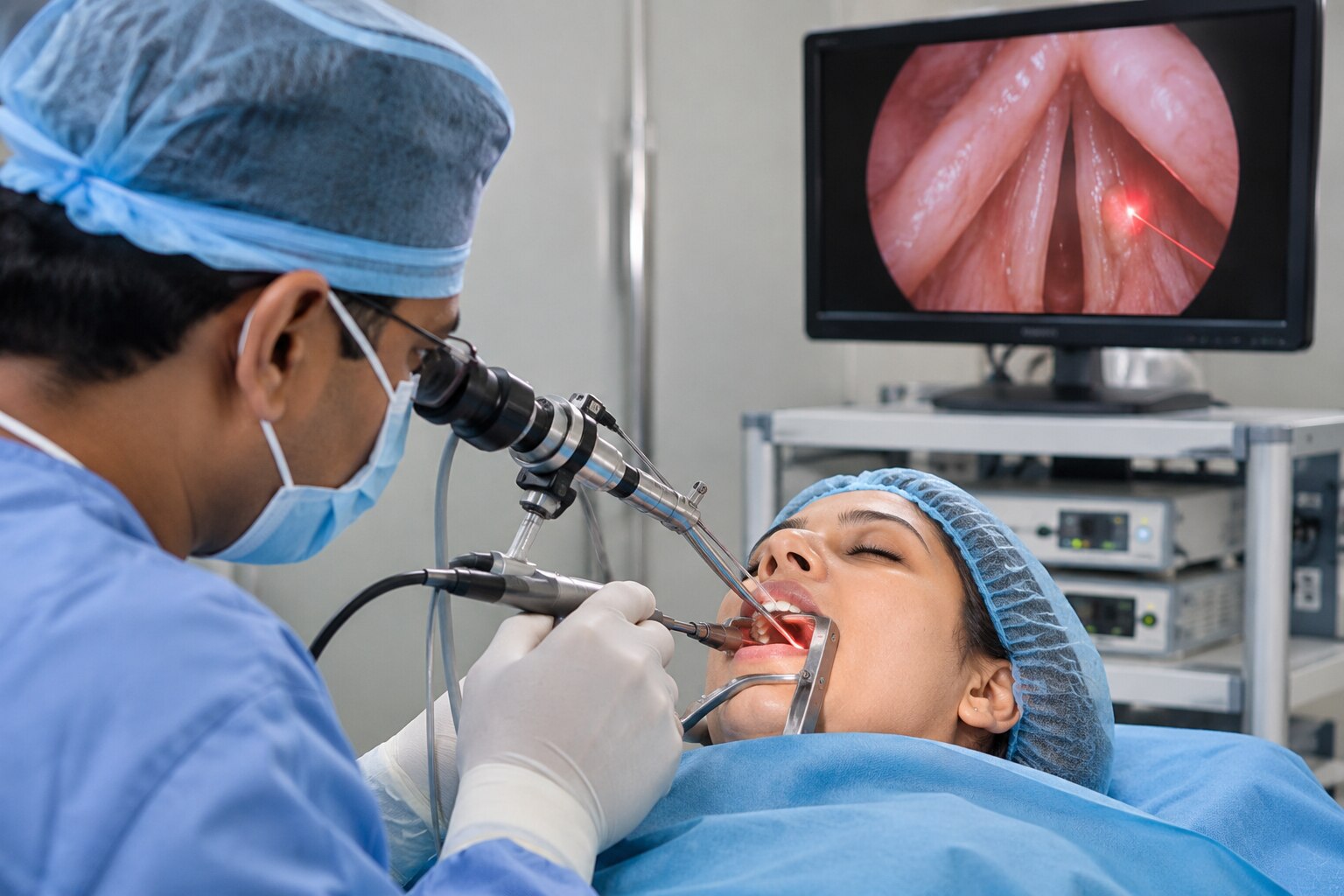
The preoperative workup starts by identifying the voice problem and examining how the vocal folds move and vibrate; it does not begin with an automatic package of blood tests or scans. By the end, you will know which tests usually establish the diagnosis, which tests are added for anesthesia or medical risk, and when biopsy or imaging becomes necessary.
Key takeaways
- Hoarseness lasting four weeks needs a direct laryngeal examination.
- Videostroboscopy shows how the vocal folds vibrate before surgery.
- Biopsy or imaging is added when examination findings require tissue or deeper assessment.
- Your anesthetist confirms blood tests and medical clearance based on your health history.
Which voice and throat tests come first?
The core laser voice surgery evaluation in Nashik starts with a detailed history and head-and-neck examination. Hoarseness lasting four weeks or longer needs laryngeal examination rather than repeated empirical treatment alone.
The doctor asks about:
- Hoarseness duration and pattern
- Smoking or tobacco exposure, reflux symptoms, and occupational voice use
- Previous intubation or throat surgery
- Current medicines
- Swallowing difficulty, noisy breathing, or breathlessness
- Warning signs such as coughing blood, stridor, a neck lump, or unexplained weight loss
| Test | How it is performed | What the doctor records |
|---|---|---|
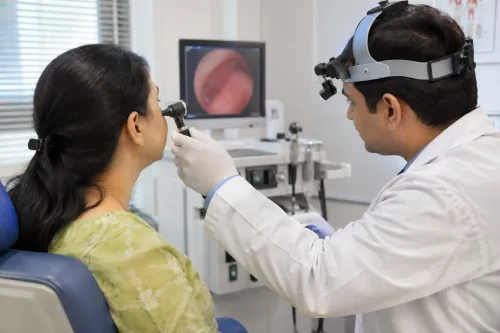
| Flexible laryngoscopy | A thin camera passes through the nose to view the larynx | Vocal-fold movement, closure, symmetry, airway narrowing, secretion pooling, swelling, lesion location, and surface changes |
| Rigid transoral laryngoscopy | A rigid scope passes through the mouth for a direct laryngeal view | Detailed appearance of nodules, polyps, cysts, scar, papilloma, leukoplakia, paralysis, and suspicious tissue |
These are direct examinations of the larynx, not a routine mouth-and-throat check. The findings determine whether further testing or tissue sampling is needed.
Laser surgery is a technique, not a diagnosis. The suspected condition—such as a polyp, cyst, scar, papilloma, paralysis, or possible cancer—determines the test plan for your hoarseness surgery assessment.
When does videostroboscopy and voice testing change the plan?
Videostroboscopy changes surgical planning when laryngoscopy does not fully explain the voice problem or shows a subtle lesion. It uses a flashing light to create a slow-motion view of the mucosal wave, showing how each vocal fold vibrates and whether the folds close completely.
This is especially useful for distinguishing how a cyst, polyp, scar, sulcus, early epithelial disease, or another abnormality disrupts vibration and closure. A lesion that looks small may stiffen the mucosa; that finding can change the treatment.
| Finding | Possible plan | Reason |
|---|---|---|
| Normal or near-normal vibration | Observe or treat a non-surgical cause | Surgery may not improve function |
| Localised polyp or cyst with preserved surrounding mucosa | Conservative removal | Protects healthy vibrating tissue |
| Scar, sulcus, or widespread stiffness | Discuss a different approach | Removing more tissue could worsen the voice |
| Suspicious epithelial change | Tissue sampling or biopsy | Appearance and vibration cannot confirm cancer |
Videostroboscopy supplements laryngoscopy. It cannot replace biopsy when cancer is suspected.
Among voice surgery preoperative tests, a speech-language pathologist’s assessment, when available, includes perceptual grading of dysphonia, voice recording, acoustic and aerodynamic measures, maximum sustained vowel duration, pitch range, loudness, and the patient-reported Voice Handicap Index.
These measurements establish a baseline and help judge functional improvement after treatment, but they do not prove that laser treatment is required.
When are biopsy, imaging, or tissue sampling added?
Biopsy and imaging investigate the lesion itself, not general surgical fitness. During direct microlaryngoscopy under anesthesia, the surgeon can inspect the vocal folds closely and take tissue when there is leukoplakia, an ulcer, an irregular or exophytic lesion, a persistent unexplained abnormality, or concern for malignancy.
Histopathology determines whether removed tissue is benign, dysplastic, or malignant. The appearance of a laser-treated lesion cannot make that diagnosis alone, so ask whether the specimen will be sent to a pathology laboratory.
| Test | What it investigates | When it applies |
|---|---|---|
| Tissue sampling and histopathology | Cellular changes in the lesion | Suspicious surface, ulcer, leukoplakia, irregular growth, or unexplained persistence |
| CT or MRI | Deep, extralaryngeal, or anatomically hidden disease | Vocal-fold paralysis, suspected deep lesion, advanced disease, or a question endoscopy cannot answer |
| Neck and chest imaging | Possible spread and staging | Cancer suspected after laryngoscopy or biopsy |
| Cervical lymph-node assessment | Enlarged or suspicious neck nodes | Suspected or confirmed laryngeal cancer |
For isolated dysphonia, imaging follows laryngeal examination; it should not replace flexible or rigid laryngoscopy. A straightforward benign polyp or cyst usually needs lesion-focused examination and the planned voice surgery preoperative tests, not automatic cancer staging.
The hoarseness surgery assessment changes when laryngoscopy suggests malignancy. The biopsy result and examination findings then determine whether neck imaging, chest imaging, and further lymph-node assessment are needed.
Which blood tests and medical checks are needed before anesthesia?
The pre-anaesthesia workup is selected from your health, medicines, airway, and the planned operation—not from a fixed package. A complete blood count can identify anaemia, infection clues, or a low platelet count; blood glucose matters for diabetes and wound healing; kidney-function tests help with kidney disease, dehydration, diabetes, or relevant medicines.
PT/INR or other coagulation tests matter with bleeding history, liver disease, anticoagulant use, or a procedure-specific concern.
Tests before laser voice surgery in Nashik are not automatically required for every healthy patient. The anaesthetist reviews:
- Current medicines, allergies, previous anaesthesia or intubation problems, bleeding history, and pregnancy possibility when relevant
- Smoking, tobacco, alcohol, sleep apnoea, obesity, heart disease, lung disease, diabetes, hypertension, and reflux
- Mouth, jaw, neck, and airway features that could make intubation difficult
Follow the fasting instructions exactly. Do not stop anticoagulants, antiplatelet drugs, diabetes medicines, or supplements yourself; the prescribing clinician, surgeon, and anaesthetist must decide what to continue or change.
| Test or review | When it is requested | What it helps assess |
|---|---|---|
| Complete blood count | Anaemia, infection clues, or platelet concern | Oxygen-carrying capacity and bleeding risk |
| Glucose and kidney tests | Diabetes, dehydration, kidney disease, or relevant medicines | Healing, metabolic control, and medicine safety |
| PT/INR or coagulation tests | Bleeding history, liver disease, anticoagulants, or procedure concern | Clotting function |
| ECG, chest X-ray, pulmonary-function, cardiology, or respiratory testing | Older age, symptoms, poor exercise tolerance, known illness, breathlessness, stridor, or airway concern | Heart, lung, and airway risk |
These investigations are selective, not universal.
How do you confirm your personal preoperative checklist?
Bring every record that can change the plan; do not rely on a previous patient’s package for your tests before laser voice surgery in Nashik.
- Prior flexible or rigid laryngoscopy and videostroboscopy recordings, pathology reports, CT or MRI images, and their written reports
- A complete medicine list with doses, including anticoagulants, antiplatelet drugs, diabetes medicines, inhalers, and supplements
- Allergy details, previous anesthesia or intubation records, and any past airway difficulty
- Information about smoking or tobacco, sleep apnea, heart or lung disease, diabetes, and bleeding problems
Ask these questions during the consultation:
- Which procedure is planned, and is it a flexible examination, office treatment, or microlaryngoscopy under general anesthesia?
- What finding makes each requested test necessary?
- Will removed tissue be sent for histopathology?
- When must you stop eating, drinking, smoking, or taking each medicine? Never stop anticoagulants or diabetes treatment without instructions from the relevant clinicians.
| Planned procedure | Workup to compare | Why it matters |
|---|---|---|
| Flexible examination | Laryngeal examination, with selective voice testing | Directly assesses the suspected lesion without general anesthesia |
| Office treatment | Examination, medical history, and procedure-specific review | The setting and treatment determine whether anesthesia tests apply |
| Microlaryngoscopy under general anesthesia | Airway and anesthesia review, with risk-based blood, cardiac, or respiratory tests | General anesthesia adds fasting, airway, and medical-fitness requirements |
Consent forms, pregnancy testing, infection screening, or recent laboratory reports can be facility-specific administrative requirements, not universal voice-surgery tests. Omkar ENT Hospital - 08042755812 can match the laser voice surgery evaluation in Nashik to your lesion and medical history; ask for the final checklist in writing.
Related service
Beat laryngeal voice sparing laser operation ₹50000 What is Voice Surgery? Voice surgery, or laser vocal cord surgery, is a medical procedure that uses laser technology to address issues affecting the... View service → |
Frequently asked questions
Which tests come first before laser voice surgery?
Evaluation starts with a detailed history and head-and-neck examination, followed by laryngeal examination and voice assessment.
When can videostroboscopy change the surgery plan?
Videostroboscopy can show vocal-fold vibration, closure, stiffness and lesion depth, helping the surgeon choose or modify treatment.
When are biopsy, imaging or tissue sampling needed?
These tests are added when the laryngeal examination shows a lesion that needs diagnosis, assessment of its extent or confirmation of tissue changes.
Which blood tests are needed before anesthesia?
The anesthetist selects preoperative blood tests and medical checks according to your health history, medicines, planned procedure and anesthesia risks.
How do you confirm your personal preoperative checklist?
Ask the ENT surgeon and anesthetist for a written checklist covering voice tests, laryngeal findings, tissue testing, blood work, medicines and medical clearance.
Keywords