
Recurring neck swelling, throat pressure, hoarseness or swallowing trouble does not automatically mean that the thyroid needs an operation. You will be able to separate thyroid symptoms from other neck conditions, understand the tests that guide the decision, and weigh surgery against observation, medicines or other treatments.
Key takeaways
- Recurring neck symptoms do not automatically mean thyroid disease or require surgery.
- Ultrasound, thyroid blood tests and FNAC help identify the cause of swelling.
- Surgery is considered for cancer risk, pressure symptoms, overactive nodules or large growths.
- Compare surgeon experience, pathology access, follow-up plans and total treatment costs.
Do recurring neck symptoms point to the thyroid or another condition?
Recurring neck symptoms justify a thyroid-focused assessment only when the pattern points to thyroid tissue; they do not, by themselves, justify thyroid surgery for recurring neck symptoms in Nashik.
A swelling that moves when you swallow, pressure at the lower front of the neck, visible growth, or symptoms linked to a known thyroid nodule supports thyroid evaluation.
| Possible source | Clues that support it | Does recurrence alone justify thyroid surgery? |
|---|---|---|
| Thyroid nodule or goitre | Lump moves with swallowing; lower-front neck pressure; visible enlargement | No; examination, blood tests and ultrasound come first |
| Cervical lymph nodes or tonsils | Lump along the side of the neck; sore throat; recent infection or tonsil symptoms | No; treat or investigate the underlying cause |
| Salivary gland | Swelling near the jaw, especially around meals | No; this needs salivary-gland assessment |
| Muscle pain, reflux or laryngeal disease | Pain with movement, throat irritation, globus sensation, cough or voice symptoms | No; surgery will not automatically correct these problems |
Record how long each episode lasts, what triggers it, whether the lump grows, and whether swallowing, breathing or voice changes.
Seek prompt assessment for:
- Rapid enlargement or a hard, fixed lump
- Breathing difficulty or trouble swallowing liquids
- Coughing or choking while eating
- Persistent hoarseness
- Coughing blood
- Unexplained weight loss
These signs need medical evaluation rather than repeated empirical treatment. A symptom referred from the chest or another organ also requires its own investigation, not thyroid surgery.
Which tests show whether a recurring neck swelling is thyroid-related?
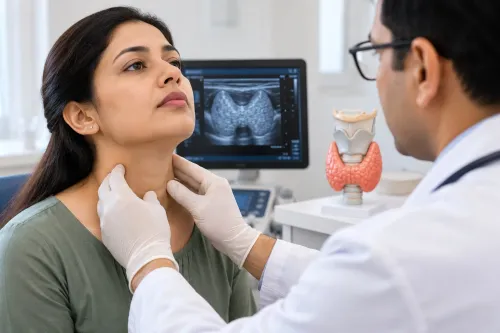
Examination, TSH, free T4 and neck ultrasound usually establish whether a recurring swelling is thyroid-related before recommending a thyroid gland operation in Nashik. The clinician checks thyroid movement, firmness, size and nearby lymph nodes. Ultrasound separates thyroid tissue from enlarged cervical lymph nodes and cystic lesions; nodule size alone does not determine biopsy or surgery.
Ultrasound wording provides the risk clues:
| Ultrasound wording | What it may indicate | Usual consequence |
|---|---|---|
| Solid or partly cystic | Solid tissue deserves closer risk assessment; a purely cystic lesion is often less suspicious | Consider ACR TI-RADS scoring |
| Irregular margins, microcalcifications or other punctate echogenic foci | Suspicious nodule features | Ultrasound-guided fine-needle aspiration cytology may be advised |
| Taller-than-wide shape or extrathyroidal extension | Higher concern for invasive disease | Prompt biopsy and specialist planning |
| Abnormal cervical lymph nodes | Possible spread or a non-thyroid cause of swelling | Sample the node or thyroid lesion |
| ACR TI-RADS category | Combines composition, echogenicity, shape, margins and foci | Sets follow-up or biopsy thresholds |
A suspicious pattern guides ultrasound-guided fine-needle aspiration cytology. The Bethesda category then influences observation, repeat sampling, molecular assessment or surgery. A benign result usually leads to ultrasound surveillance, but repeated nondiagnostic samples, growth, pressure symptoms or clinical concern can change the plan.
CT with contrast helps map selected large, deep or compressive lesions. Examine the vocal cords for hoarseness, previous neck surgery, invasive disease or a lesion near the recurrent laryngeal nerve.
When is thyroid surgery needed instead of observation or other treatment?
For anyone asking when is thyroid surgery needed in Nashik, the decision rests on documented thyroid disease, not recurring symptoms alone. Surgery is usually considered for confirmed or strongly suspected cancer, an indeterminate nodule with enough cancer risk to justify diagnostic removal, or a large goitre compressing the airway or oesophagus.
Selected hormone-producing nodules also need definitive treatment.
| Option | What it does | When it fits |
|---|---|---|
| Observation | Uses repeat examination, TSH testing and ultrasound | Reassuring ultrasound and benign cytology without significant growth or compression |
| Thyroid medicine | Controls excess hormone | Temporary control when surgery or radioactive iodine is unsuitable; it does not remove autonomous tissue |
| Radioactive iodine | Destroys overactive thyroid tissue | Suitable toxic solitary nodules or toxic multinodular goitre when pregnancy and cancer concerns do not exclude it |
| Surgery | Removes part or all of the gland | Large goitre, cancer concern, selected hormone overproduction, pregnancy-related treatment constraints or patient preference |
A partial thyroidectomy, usually lobectomy with isthmusectomy, removes one lobe and may preserve hormone production. Total thyroidectomy removes both lobes and is more likely for bilateral disease, selected cancer, or hormone production throughout both lobes; it requires lifelong levothyroxine. Completion thyroidectomy removes the remaining lobe after an earlier partial operation.
A thyroid gland operation in Nashik can fix compression, cancer and selected hormone overproduction. It cannot promise relief from reflux, globus, nonspecific pain or unrelated throat disease. Trade-offs include a neck scar, pain, voice change, low calcium, bleeding and infection; total surgery carries greater low-calcium risk.
How should you compare a thyroid specialist hospital in Nashik before agreeing to surgery?
A thyroid specialist hospital in Nashik should show how evidence supports surgery, not rely on recurring symptoms alone. Compare access to high-quality ultrasound, ultrasound-guided biopsy, cytology and pathology review, anaesthesia with airway support, postoperative calcium and voice monitoring, emergency contact arrangements, and thyroid-hormone follow-up.
| Service to compare | What to verify |
|---|---|
| Ultrasound and biopsy | ACR TI-RADS category, ultrasound-guided sampling, and Bethesda cytology category |
| Surgical plan | Lobectomy or total thyroidectomy, proposed extent, lymph-node surgery, and the reason for each |
| Safety planning | Recurrent laryngeal-nerve and parathyroid preservation, anaesthesia, airway support, calcium and voice checks |
| Aftercare | Pathology timing, emergency contact, scar expectations, TSH testing and medication follow-up |
Ask for the report, not a verbal label. Clarify the Bethesda category, the expected scar, when final pathology will arrive, and how levothyroxine decisions will be made. Ask whether lymph-node surgery is needed and what evidence supports it.
A second opinion is sensible when surgery rests only on symptoms, cytology is indeterminate, or total thyroidectomy is proposed for a small, low-risk nodule.
Omkar ENT Hospital - 08042755812 can fit this process by assessing recurring symptoms, arranging thyroid evaluation, referring or performing appropriate head-and-neck surgery, and planning follow-up; the assessment should decide whether an operation is appropriate, not assume every recurrence needs one.
Related services
thyroid and parotid glands operations ₹100000 What is Head & Neck Cancer Surgery? Head and neck cancer surgery is a treatment approach for cancers that originate in the head and neck region,... View service → |
thyroid gland surgery for complete cure and relief Thyroid ₹65000 What is the Thyroid Gland? The thyroid is a small, butterfly-shaped gland located in the front of the neck, just below the Adam's apple. |
What preparation, recovery and ongoing costs should you plan for?
Before a thyroid gland operation in Nashik, give the team every medication, supplement and allergy, including blood thinners and diabetes medicines. Follow the hospital’s fasting time exactly; anaesthesia instructions often specify when to stop food, water and tablets. Arrange transport home and an adult to support you during the first recovery period.
Keep the incision clean and dry as instructed, and do not apply creams unless approved. Follow the operating team’s specific limits on lifting, driving and strenuous activity. Report voice changes rather than ignoring them. Seek urgent contact for:
- Rapidly increasing neck swelling, breathing difficulty or bleeding
- Fever or worsening wound redness
- Tingling around the mouth or fingers
- Muscle cramps or spasms
Reduced parathyroid function can require calcium and vitamin D. Pathology confirms what was removed and helps determine whether further treatment is needed. After lobectomy, check TSH because hypothyroidism can still develop; after total thyroidectomy or some completion procedures, lifelong levothyroxine and dose adjustment based on repeat TSH are expected.
| Cost beyond the operation | What to include |
|---|---|
| Consultations and tests | TSH, free T4, ultrasound, biopsy and CT when required |
| Hospital and recovery | Pathology, medicines, transport and time away from work |
| Ongoing care | Repeat thyroid-function testing and long-term levothyroxine management |
Thyroid surgery for recurring neck symptoms in Nashik should match documented thyroid disease, not recurrence alone.
Frequently asked questions
Do recurring neck symptoms always point to the thyroid?
No. Neck swelling or discomfort can also come from lymph nodes, salivary glands, infection, muscle strain or other conditions. A thyroid-focused assessment is appropriate when the swelling is in the thyroid region, moves on swallowing, or occurs with thyroid-related test changes.
Which tests assess recurring thyroid swelling?
A clinician may order a neck and thyroid ultrasound, thyroid-stimulating hormone and free T4 blood tests, and fine-needle aspiration cytology when ultrasound findings require cell examination. The test combination depends on the examination and imaging findings.
When is thyroid surgery needed in Nashik?
Surgery is considered when a nodule or gland has cancer or suspicious FNAC findings, causes breathing or swallowing pressure, produces excess thyroid hormone in a suitable case, or continues to enlarge. Observation or other treatment can be safer when testing shows low risk and symptoms are mild.
How should you compare a thyroid specialist hospital in Nashik?
Ask who will perform the operation, how ultrasound-guided FNAC and pathology are arranged, whether vocal-cord and calcium monitoring are included, what follow-up is provided, and which costs are included in the written estimate.
What preparation and recovery should you plan for thyroid surgery?
Plan for a preoperative examination, blood tests, medication review and anaesthesia assessment. After surgery, arrange wound care and follow-up; ask about activity limits, voice changes, calcium symptoms, thyroid hormone replacement and the timing of pathology results.
Keywords