A thyroid lump does not automatically mean cancer or an operation. You will be able to follow the pathway from medical history and examination through blood tests, ultrasound, biopsy, surveillance and the specific findings that make surgery worthwhile.
Key takeaways
- Ask about thyroid blood tests and a neck ultrasound before discussing surgery.
- Monitoring is reasonable when ultrasound and FNAC show low-risk features.
- An unclear FNAC sample may require repeat sampling or diagnostic surgery.
- Discuss voice change, low calcium and the extent of surgery before consenting.
The first appointment: separating a nodule, goitre and urgent warning signs
A thyroid lump is not automatically a surgical problem: the first evaluation separates a focal nodule from an enlarged gland, then checks for features that need rapid investigation. Your clinician asks when it appeared, whether it is growing, and whether you have difficulty swallowing, breathing or speaking.
Mention childhood neck radiation, thyroid cancer in relatives, previous thyroid disease and symptoms such as tremor, weight change or palpitations.
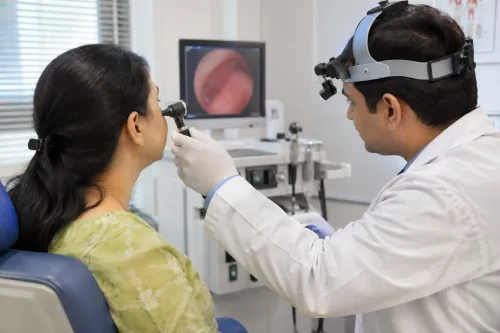
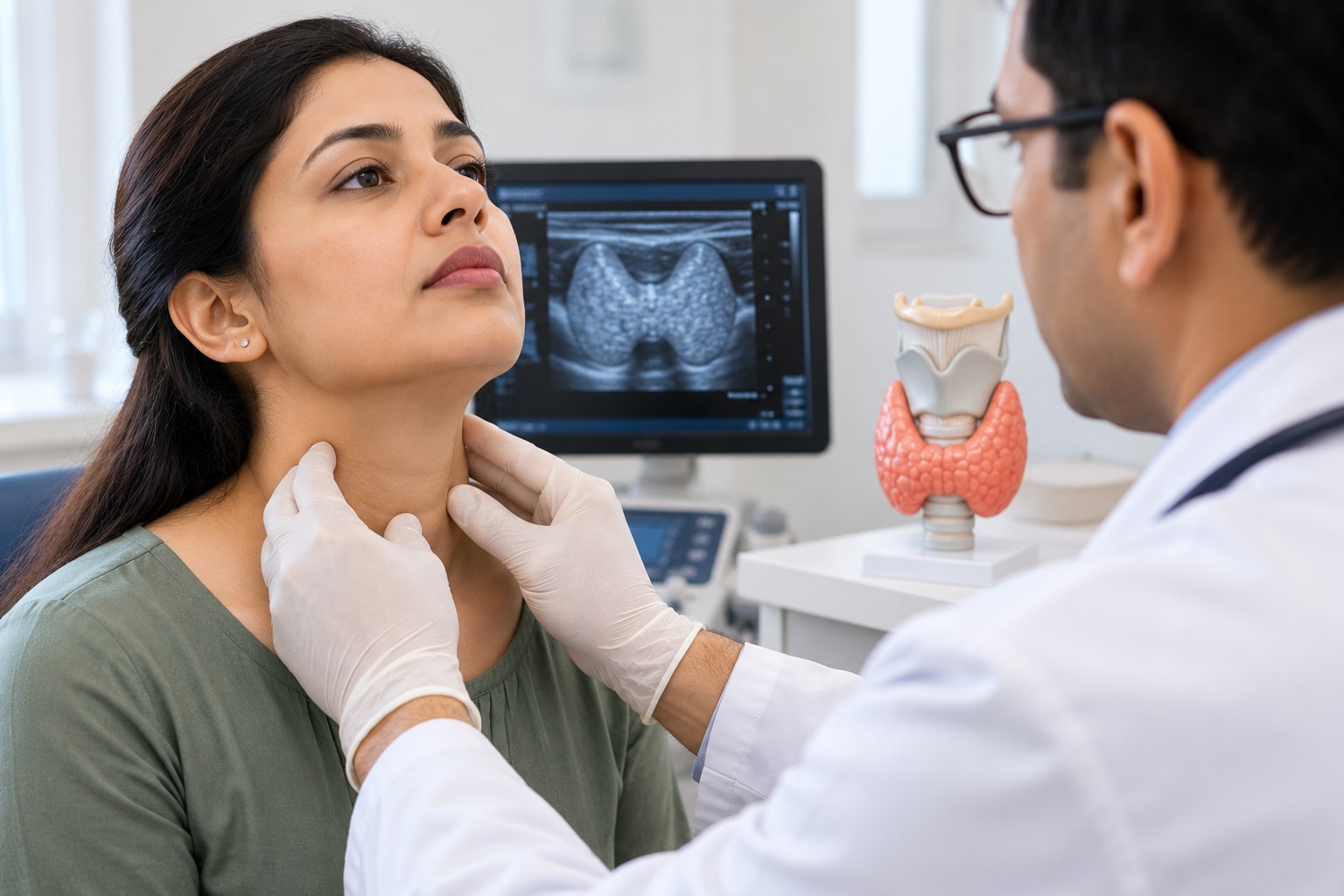
During examination, the clinician feels the thyroid while you swallow and checks the neck for hard or fixed lumps, enlarged lymph nodes, tenderness and movement. The assessment usually leads to TSH and free T4 blood tests plus a neck ultrasound. This Thyroid Surgery Evaluation for Nodules does not mean an operation is inevitable.
- Seek emergency care for severe breathing difficulty, noisy breathing or inability to swallow saliva.
- Arrange faster assessment for a rapidly enlarging neck lump, persistent hoarseness, a hard fixed nodule, enlarged neck nodes, or pressure symptoms that worsen when lying down.
- Ask whether the lump extends behind the breastbone; substernal goitre can compress the airway or food pipe and may need surgical planning.
| Finding | What it usually describes | What changes the next step |
|---|---|---|
| Nodule | One focal lump within the thyroid | Ultrasound features and size determine surveillance or FNAC |
| Goitre | An enlarged thyroid, with or without nodules | Assess thyroid function, pressure symptoms and substernal extension |
| Urgent warning sign | Rapid growth, airway trouble, persistent hoarseness or suspicious nodes | Prompt imaging, specialist review and possible tissue testing |
Thyroid-function blood tests and neck ultrasound: what the results reveal
TSH is the first decision point. A low or suppressed TSH suggests an overactive thyroid; free T4 shows whether that excess hormone is overt or mild. If TSH is suppressed, a radionuclide scan can identify a “hot” nodule, which is rarely malignant and is usually not biopsied like a nonfunctioning nodule.
Ultrasound still checks the remaining thyroid and neck lymph nodes.
A normal TSH and free T4 show normal thyroid function, not a harmless nodule. Most thyroid cancers occur with normal blood tests, so normal results do not exclude cancer. High TSH with low free T4 indicates underactive thyroid function, but it also does not prove that a nodule is cancerous.
The ultrasound report determines how suspicious the structure looks and whether sampling or surveillance is appropriate. Size matters, but so do a solid rather than cystic structure, marked hypoechogenicity, irregular margins, punctate calcifications, a taller-than-wide shape, and abnormal lymph nodes.
The TI-RADS category combines these features; it guides the threshold for fine-needle aspiration cytology or repeat ultrasound, rather than providing a cancer diagnosis.
- Review TSH and free T4 to identify overactive, underactive or normal function.
- Arrange radionuclide scanning when TSH is suppressed; treat the scan result alongside the ultrasound.
- Match ultrasound size and TI-RADS features with the recommended biopsy threshold.
- Proceed to FNAC when indicated, because only cytology or surgical histopathology can establish the next cancer-related decision.
When monitoring is safer than immediate surgery
Observation is reasonable when ultrasound shows low or very low suspicion, the nodule is below the relevant biopsy threshold, and you have no compressive symptoms or suspicious lymph nodes. A benign-appearing scan does not prove benign disease; it supports surveillance when the whole clinical picture is reassuring.
The interval comes from ultrasound risk category, size, previous growth and symptoms—not from the word “goitre” alone.
A commonly used ACR TI-RADS schedule, when the nodule meets its size threshold for follow-up, is:
| Ultrasound category | Typical repeat ultrasound schedule | What changes the plan |
|---|---|---|
| TR3, mildly suspicious | At 1, 3 and 5 years | Growth or new suspicious features |
| TR4, moderately suspicious | At 1, 2, 3 and 5 years | Growth, suspicious lymph nodes or a change toward TR5 |
| TR5, highly suspicious | Every year for 5 years | Earlier biopsy or treatment if size or findings qualify |
Growth means at least a 20% increase in two dimensions with a minimum 2 mm increase, or a volume increase above 50%. A stable nodule does not need immediate surgery, but stability does not cancel new symptoms or a new suspicious feature.
Repeat imaging sooner when you develop difficulty swallowing or breathing, notice rapid neck enlargement, or when the scan shows suspicious lymph nodes or extension behind the breastbone. A large goitre also needs assessment of airway and oesophageal pressure, not just measurements of its nodules.
FNAC results and the decisions after an unclear sample
FNAC is recommended when a nodule reaches the ultrasound-based size threshold or has suspicious features, not automatically for every nodule. Fine-needle aspiration cytology uses a thin needle to collect cells. A rapidly enlarging lump, abnormal lymph nodes or voice change increases the need for prompt sampling.
| Bethesda category | Cytology meaning | Usual next decision |
|---|---|---|
| I | Non-diagnostic or too few cells | Repeat ultrasound-guided FNAC |
| II | Benign | Observation with planned ultrasound |
| III | Atypia of undetermined significance | Repeat FNAC or molecular testing; observe selected low-risk nodules |
| IV | Follicular neoplasm or suspicious follicular pattern | Molecular testing or diagnostic lobectomy |
| V | Suspicious for malignancy | Lobectomy or total thyroidectomy, based on tumour and patient factors |
| VI | Malignant cells | Cancer surgery and staging |
Core biopsy uses a wider needle to remove a small tissue cylinder, preserving tissue architecture rather than collecting loose cells. It can help after repeated non-diagnostic FNAC or when lymphoma or another non-thyroid lesion is suspected, but it does not routinely replace FNAC.
FNAC cannot reliably separate follicular adenoma from follicular carcinoma because invasion of the capsule or blood vessels is visible only in excised tissue.
Before accepting an “unclear” result, ask whether the slide was Bethesda I, III or IV, whether a repeat sample or molecular test is useful locally, and why lobectomy is proposed. Discuss voice change and low calcium before surgery; low calcium is chiefly a total-thyroidectomy risk, not an isolated-lobectomy risk.
Choosing the operation and checking safety before thyroid surgery in Nashik
Lobectomy removes one thyroid lobe and is reasonable for a single, confined nodule with indeterminate or suspicious cytology when there is no spread, opposite-lobe disease or major compression. Total thyroidectomy is justified for cancer involving both lobes, clear spread to lymph nodes or beyond the thyroid, selected large or substernal goitres, or bilateral toxic disease.
A benign nodule without pressure symptoms, significant growth or troublesome cosmetic effects does not automatically need surgery.
| Option | Main benefit | Main cost or consequence |
|---|---|---|
| Lobectomy | Treats a one-sided lesion while preserving the opposite lobe | Cancer found on final pathology may require completion surgery; some patients still need thyroid hormone |
| Total thyroidectomy | Removes both lobes when disease is bilateral or extensive | Lifelong thyroid-hormone replacement; greater risk of low calcium and voice-nerve injury |
Before choosing a team for Thyroid surgery in Nashik, ask:
- Will you examine vocal-cord movement before surgery, even if my voice sounds normal? Ask how persistent hoarseness and breathing difficulty after surgery are assessed.
- How will you protect and monitor the parathyroid glands? Ask when calcium and vitamin D will be checked, and which symptoms—mouth or finger tingling, cramps or spasms—require urgent contact.
- Who reviews the final histopathology, and when will the report determine completion surgery, radioactive iodine or observation?
- What exact follow-up includes neck examination, TSH testing, ultrasound and hormone-dose adjustment?
Omkar ENT Hospital - 08042755812 is one local consultation option where you can ask these questions alongside the ultrasound and FNAC reports.
Related services
thyroid gland surgery for complete cure and relief Thyroid ₹65000 What is the Thyroid Gland? The thyroid is a small, butterfly-shaped gland located in the front of the neck, just below the Adam's apple. |
thyroid and parotid glands operations ₹100000 What is Head & Neck Cancer Surgery? Head and neck cancer surgery is a treatment approach for cancers that originate in the head and neck region,... View service → |
Frequently asked questions
What happens during a thyroid surgery evaluation for a nodule or goitre?
The clinician reviews when the lump appeared, whether it is growing, and whether you have difficulty swallowing, breathing or speaking. Examination then separates a focal nodule from an enlarged thyroid gland and identifies urgent warning signs.
What do thyroid-function blood tests and neck ultrasound show?
Blood tests assess thyroid hormone production, while neck ultrasound shows the nodule’s size, solid or fluid-filled composition, margins, calcifications and lymph nodes. These findings help determine whether observation, FNAC or surgery is appropriate.
When is monitoring safer than immediate thyroid surgery?
Monitoring is appropriate when the nodule has low-risk ultrasound features, thyroid function is stable and FNAC does not suggest cancer. Follow-up usually compares symptoms, examination findings and ultrasound changes over time.
What happens after an unclear FNAC result?
An unclear fine-needle aspiration cytology result may lead to a repeat ultrasound-guided sample, additional assessment or diagnostic surgery. The choice depends on the ultrasound pattern, nodule size, symptoms and patient preferences.
What safety issues should you discuss before thyroid surgery in Nashik?
Ask about the planned operation, risks of voice change from nerve injury, low calcium from parathyroid effects, bleeding, thyroid hormone replacement and the checks required before anaesthesia.