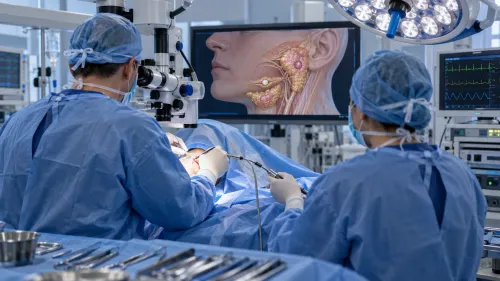


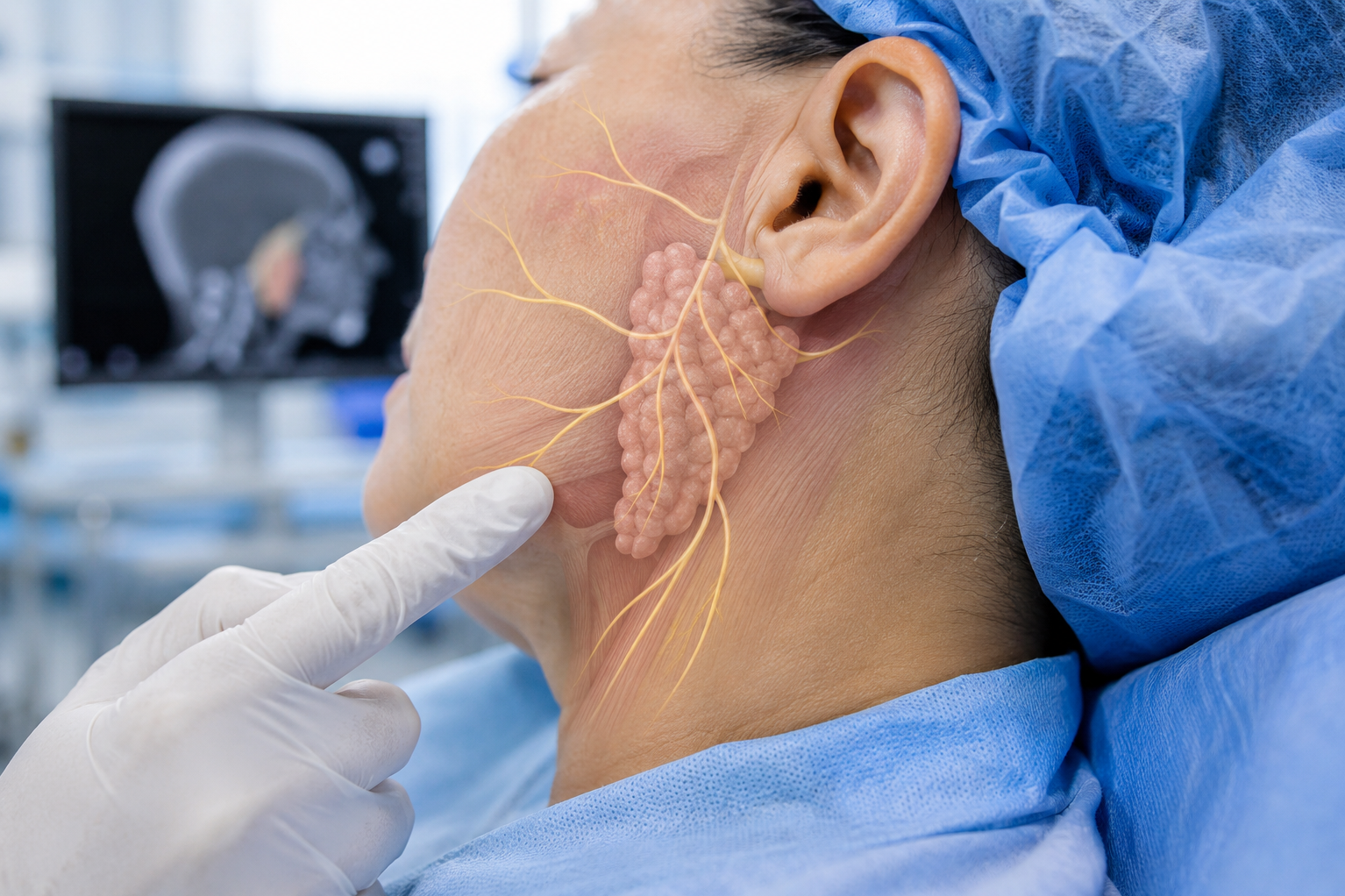
A lump near the ear or jaw may originate from the parotid gland, the largest of the salivary glands. Many parotid tumours are benign, but physical examination alone cannot reliably identify every swelling. Specialist assessment is important because the facial nerve passes through the gland.
Parotid surgery requires careful planning to remove the affected tissue while protecting facial movement whenever medically possible.
How Parotid Swellings Present
A parotid growth commonly appears as a slow-growing lump in front of or below the ear. Some patients notice it accidentally while shaving, applying makeup or looking in a mirror.
Features that warrant prompt investigation include:
- Rapid increase in size
- Pain or tenderness
- Facial weakness
- Numbness
- Difficulty opening the mouth
- Skin changes over the swelling
- Enlarged neck lymph nodes
- A lump that feels fixed
These features do not confirm cancer, but they may influence the urgency and extent of investigation.
Tests Before Parotid Surgery
The surgeon examines the location and mobility of the swelling and checks facial movement. Ultrasound is often used to determine whether the lump is within the gland and to examine nearby lymph nodes.
Fine-needle aspiration or core biopsy may provide information about the type of tumour. MRI or CT imaging can be helpful for deep, large, recurrent or potentially malignant growths.
A complete assessment answers several questions:
- Is the lesion actually within the parotid gland?
- Does it involve the superficial or deep portion?
- Are there suspicious lymph nodes?
- Is the facial nerve functioning normally?
- Is the condition likely benign, malignant or inflammatory?
Types of Parotid Operations
A superficial parotidectomy removes tissue from the portion of the gland lying over the facial nerve. A total parotidectomy addresses both superficial and deep portions when required. In selected cases, a limited operation may be considered, depending on tumour type and location.
The operation is tailored to the diagnosis. A confirmed or suspected cancer may require wider removal and evaluation or treatment of neck lymph nodes. Additional therapy is determined by the final pathology report.
National Cancer Institute information confirms that salivary gland cancer treatment may include surgery, radiotherapy and other treatments depending on tumour stage and biological features. Review the patient overview of salivary gland treatment.
Facial Nerve Considerations
The facial nerve divides into branches within the parotid gland and controls forehead movement, eye closure and smiling. During surgery, the nerve is identified and carefully separated from the gland.
Temporary weakness can occur because the nerve may be stretched or handled during removal. Permanent weakness is less common but may occur when a tumour surrounds or directly involves a nerve branch. The surgeon should discuss this possibility before treatment.
Other considerations include bleeding, infection, fluid collection, numbness around the ear, visible contour change and sweating over the cheek while eating.
Selecting Surgical Care in Nashik
Patients considering parotid surgery in Nashik should look for a surgeon experienced in both salivary gland anatomy and head and neck disease. The consultation should cover the likely diagnosis, planned extent of surgery, facial nerve risk and expected scar position.
At Omkar ENT Hospital, parotid swellings are assessed using clinical findings, appropriate imaging and tissue sampling before an operation is planned.
No parotid lump should be removed casually or without diagnostic preparation. A methodical approach helps the surgeon choose the correct operation, counsel the patient realistically and preserve important facial functions wherever the disease permits.