Hearing difficulty is not always marked by pain, discharge, or a blocked ear. You may hear conversation in a quiet room yet miss words in traffic, restaurants, meetings, or family gatherings. By the end, you will know which signs justify specialist review, what the main hearing tests reveal, and when a result needs urgent follow-up.
Key takeaways
- Speech comprehension does not rule out measurable hearing loss.
- Ask for pure-tone audiometry, speech testing, and tympanometry when symptoms persist.
- An ENT can investigate ear disease, nerve-related loss, and blocked sound transmission.
- Children need follow-up when hearing affects speech, learning, attention, or behaviour.
Why hearing loss can stay hidden during ordinary conversation
You can follow a basic conversation and still have measurable hearing loss because ordinary speech is predictable, close, and supported by facial cues.
Mild loss may remove only soft consonants or high-frequency sounds, so you hear the voice but miss words such as “fifteen” or “sixty.” A quiet conversation tests coping, not the faintest sounds you can detect.
The difficulty becomes clearer in a restaurant, meeting, classroom, or family gathering, where background noise masks speech. You may ask people to repeat themselves, turn up the television, rely on lip-reading, or hear well with one ear while the other performs poorly.
Tinnitus, sound sensitivity, or fluctuating hearing can also signal a problem without pain, discharge, or a blocked-ear sensation.
A calibrated pure-tone audiogram measures hearing thresholds across frequencies, while speech testing checks how clearly you detect or understand spoken words. An ENT hearing consultation for hidden hearing problems in Nashik can connect these results with your history and an ear examination, rather than treating a screening result as a diagnosis.
Early hearing problem detection matters because treatment, communication strategies, or hearing rehabilitation become harder to arrange after months of avoidable delay. Persistent one-sided symptoms or rapidly worsening hearing require specialist assessment even when conversation still seems normal.
What happens during a specialist hearing evaluation
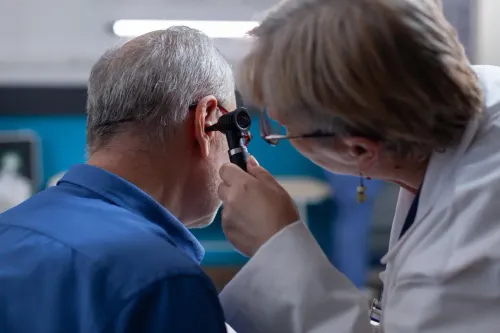
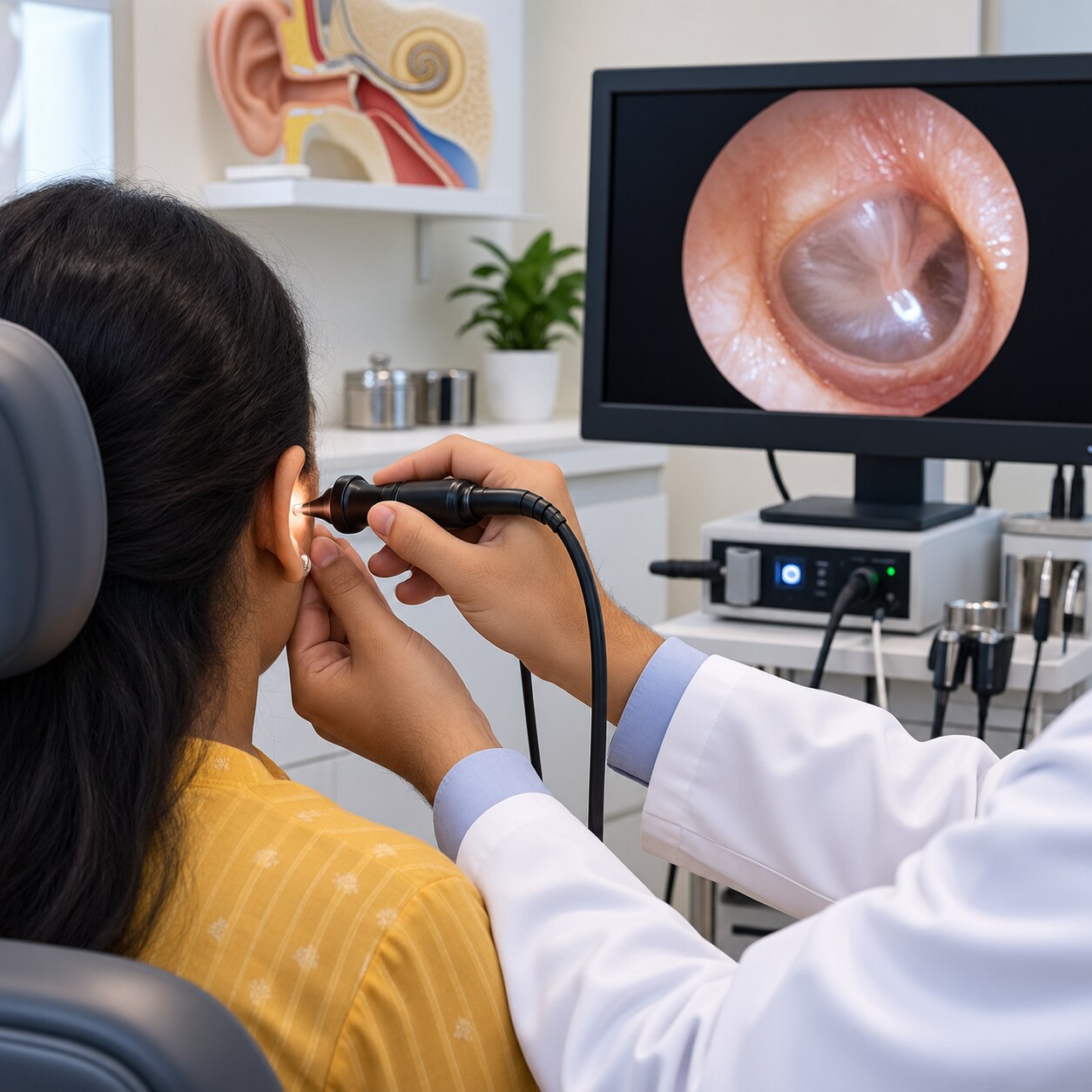
Otoscopy comes before the hearing machine: it lets the clinician inspect the ear canal and eardrum for wax, infection, swelling, perforation, fluid signs, or other visible problems. The history also matters—onset, one- or two-sided symptoms, tinnitus, vertigo, noise or medication exposure, discharge, and fluctuating hearing help direct the tests.
| Site | Examination or test | What it can show |
|---|---|---|
| Outer ear | Otoscopy | Wax, otitis externa, canal narrowing, or an obstruction causing conductive loss |
| Middle ear | Tympanometry | Eardrum movement, middle-ear fluid, negative pressure, perforation, or an abnormal ossicular system |
| Middle ear versus inner ear | Calibrated diagnostic audiometry with air and bone conduction | A gap between air and bone thresholds supports conductive loss; reduced thresholds through both routes supports sensorineural loss |
| Speech pathway | Speech audiometry | Whether you detect and understand spoken words, including performance that seems worse than pure-tone thresholds suggest |
| Inner ear or auditory nerve | Otoacoustic emissions (OAE) or auditory brainstem response (ABR) | Cochlear outer-hair-cell function or transmission along the auditory pathway when routine results are unclear |
A specialist hearing evaluation should compare each ear separately, not average them. Persistent one-sided or asymmetric sensorineural loss, unilateral tinnitus, or neurological signs can lead to vestibular testing, magnetic resonance imaging, or other specialist investigation for conditions such as vestibular schwannoma.
One of the ENT hearing assessment benefits is finding a treatable blockage without blaming wax for every complaint. Hearing loss developing within three days, especially in one ear, needs urgent assessment because sudden inner-ear loss is time-sensitive; a screening result cannot diagnose it.
How test results reveal the type and cause of hearing loss
An audiogram shows more than whether hearing is “normal.” It records the degree, frequency pattern, and side of the loss. A gap between air- and bone-conduction thresholds points toward a conductive problem in the outer or middle ear, while raised thresholds without that gap suggest sensorineural loss from the inner ear or hearing nerve.
Speech testing adds a functional result. Speech detection shows the softest level at which you recognise words; word recognition shows how clearly you understand them. Poor word recognition despite usable tone thresholds raises concern about cochlear distortion, nerve involvement, or difficulty processing speech in noise.
Tympanometry checks how the eardrum and middle-ear system respond to pressure. A flat trace can support middle-ear fluid or a perforation, while strongly negative pressure supports poor Eustachian-tube function. Otoscopy helps confirm whether the trace matches what the clinician sees rather than treating one graph as a diagnosis.
The findings must match your symptoms, ear examination, and earlier results. A hearing problem diagnosis in Nashik should not average the two ears: persistent one-sided or asymmetric sensorineural loss deserves separate attention, especially with unilateral tinnitus or neurological symptoms. An unexpected mismatch calls for repeat testing or referral during a specialist hearing evaluation.
When an ENT consultation is more appropriate than a hearing aid or screening
Buying a hearing aid before identifying the cause can hide a treatable problem and produce poor results. Choose medical assessment when hearing changes are new, one-sided, fluctuating, asymmetric, or difficult to explain from a basic screening result.
A general physician can address broad health issues, but an ENT can examine the ear and connect symptoms with the hearing pattern.
Arrange an ENT review promptly if you have:
- Rapidly worsening hearing, especially in one ear
- Persistent one-sided tinnitus or a clear difference between ears
- Recurrent vertigo, imbalance, facial weakness, numbness, or other neurological symptoms
- Ear pain, discharge, repeated infections, or a blocked sensation that does not settle
- Difficulty understanding speech despite hearing sounds, particularly in background noise
A screening test, tuning-fork check, or phone app can indicate that further testing is needed; it cannot diagnose the cause. An ENT consultation can include otoscopy, calibrated pure-tone and speech audiometry, and tympanometry, with OAE, ABR, imaging, or vestibular testing when the findings warrant them.
The ent hearing assessment benefits include detecting asymmetry and reconciling test results with symptoms rather than averaging both ears.
For an ent consultation for hidden hearing problems in Nashik, Omkar ENT Hospital - 08042755812 can help assess whether you need diagnostic testing, treatment for an ear condition, or referral before considering a hearing device.
Related service
Sleep with sound mind peaceful nights Snoring ₹100000 What is Snoring? Snoring is a harsh sound, a common condition characterized by the sound produced during sleep when the flow of air through the mouth... |
Why children and people with near-normal results still need follow-up
Do not close the case because the ear looks normal or the audiogram falls within an acceptable range. Background noise, tinnitus, sound intolerance, high-frequency difficulty, and one-sided hearing loss can remain hidden during routine conversation.
Ask for speech-in-noise testing or another targeted assessment when you understand quiet speech but struggle in restaurants, meetings, classrooms, or family conversations.
A follow-up ear examination also checks for treatable problems such as impacted wax, otitis externa, middle-ear fluid, a perforation, infection, or ossicular damage. Wax should not automatically receive the blame if difficulty continues after safe removal.
Persistent unilateral hearing loss, unilateral tinnitus, or neurological symptoms need specialist review because averaging both ears can conceal asymmetry and less common inner-ear causes.
For early hearing problem detection, arrange the next step based on the listener’s age and symptoms:
- For an infant or young child, request otoacoustic emissions, automated or diagnostic auditory brainstem response, or age-appropriate behavioural audiometry when responses are unreliable.
- For a child who passed newborn screening but now has delayed speech, unclear speech, poor classroom listening, or frequent repetition requests, schedule reassessment rather than relying on the old result.
- For an adult with continuing complaints, take a real-world communication history and repeat pure-tone and speech audiometry, adding speech-in-noise testing when needed.
- For hearing problem diagnosis in nashik, bring previous reports and note which ear, situations, and sounds cause difficulty. Earlier confirmation supports treatment, communication strategies, rehabilitation, or device discussions.
Frequently asked questions
Why can hearing loss stay hidden during ordinary conversation?
Everyday conversation is close, predictable, and supported by facial cues. You may miss soft consonants, speech in noise, or sounds from one side while still following familiar talk.
What happens during a specialist hearing evaluation?
An ENT assessment can include an ear examination, pure-tone audiometry, speech audiometry, and tympanometry. The tests measure hearing sensitivity, speech understanding, and middle-ear function.
How do hearing test results show the type of hearing loss?
The pattern across frequencies and the comparison between air- and bone-conduction results help distinguish conductive loss from sensorineural or mixed loss. The ear examination and medical history help identify possible causes.
When is an ENT consultation better than a hearing aid or screening?
Choose an ENT consultation when hearing loss is sudden, one-sided, worsening, associated with pain or discharge, or accompanied by dizziness or tinnitus. A screening detects a possible problem but does not diagnose its cause.
Why do children and people with near-normal results need follow-up?
Children can have hearing-related speech, learning, or attention difficulties even when a basic result looks normal. Follow-up is also useful when symptoms continue, because hearing can fluctuate or problems can appear in specific listening conditions.