Traffic, fans, restaurant chatter and several speakers can remain difficult even when a hearing aid makes sounds louder. By the end, you will know which features and styles to compare, how to test speech understanding in real Nashik settings, and when fitting, medical review or an additional listening device is needed.
Key takeaways
- Start with an ear examination, hearing thresholds and speech-understanding tests.
- Choose directional microphones and noise reduction based on your listening environments.
- Test speech understanding in noise before committing to a hearing aid.
- Return for fine-tuning when voices remain unclear after regular use.
Start with a hearing assessment, not a louder device
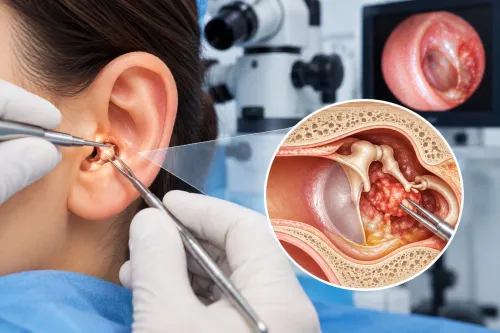
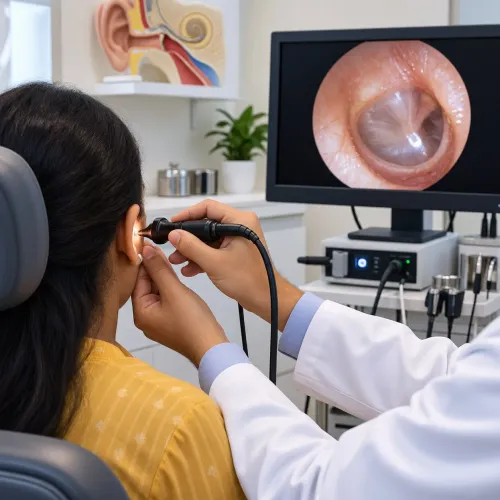
Hearing aids for conversations in noisy places in Nashik should follow a diagnostic hearing assessment, not a trial of a louder device. An ENT or audiologist should inspect the ear canal and eardrum, measure hearing thresholds, test speech understanding, and compare both ears before recommending amplification.
Medical evaluation comes first if you have:
- Impacted wax, infection, moisture, ear discharge, or severe ear pain
- Sudden or rapidly worsening hearing loss
- One-sided hearing loss or unilateral tinnitus
- Vertigo
These problems can reduce hearing or signal a condition that needs treatment. A blocked canal, damaged receiver, poor dome fit, or incorrect programming can also make a hearing aid seem ineffective.
| Both ears | Two aidable ears | Bilateral fitting can provide speech access from either side and support sound localisation |
|---|---|---|
| One ear | Only one aidable ear | One device may be appropriate after assessment |
| One-sided symptoms | Unequal hearing or tinnitus | Medical investigation before routine fitting |
A hearing aid improves access to speech; it cannot make a crowded room quiet or restore normal hearing. Tinnitus or sound sensitivity should shape the fitting discussion, including volume, programme settings, and acclimatisation.
Which features separate speech from traffic, fans and chatter?
Prioritise a hearing device for background noise in Nashik by how well it preserves speech while you move, not by how loud it sounds. Directional microphones favour sound from in front, so face the main speaker; they work poorly when speakers sit beside or behind you or are spread around a group.
| Feature | What it does | Important limitation |
|---|---|---|
| Directional microphones | Reduce some sound from the sides and rear | Less useful when the desired speaker moves |
| Automatic directionality | Changes microphone focus as the scene changes | Rapid changes can sound unstable |
| Digital noise reduction | Makes steady traffic, fans and road noise less tiring | Does not remove competing speech |
| Speech-enhancement algorithms | Emphasise speech cues against background sound | Aggressive processing can erase natural speech detail |
| Feedback management | Prevents whistling when volume is high or the fit changes | It does not separate speech from noise |
Ask for stable sound during head movement. More channels, higher maximum output and “noise cancellation” on a brochure do not prove better group performance; fitting and real-world testing matter more.
A remote microphone helps when one talker is several metres away or the room is reverberant. It sends that person’s voice directly to the aids, but favours whoever wears or holds it and cannot manage rapid exchanges among several speakers.
Match the hearing-aid style and connectivity to the group
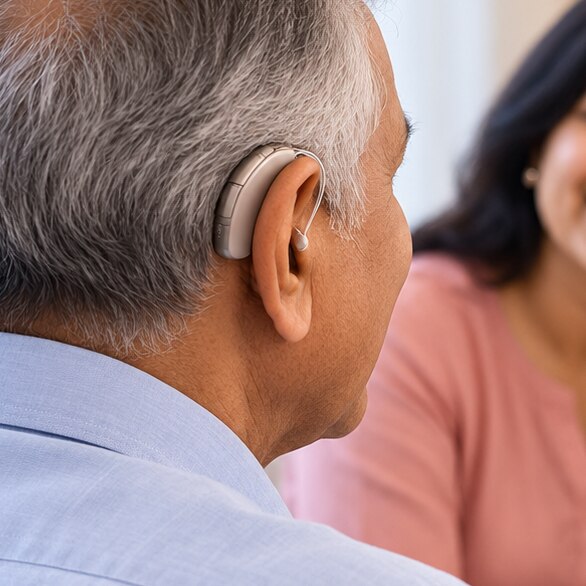
For a hearing aid for crowded places in Nashik, choose the housing around your hearing loss, distance from speakers and handling ability—not appearance alone.
| Style | Practical strengths | Trade-offs |
|---|---|---|
| Receiver-in-canal | Natural microphone position, strong receiver options, discreet | Receiver and microphones face sweat, wax and moisture; clean regularly; rechargeable or disposable batteries |
| Behind-the-ear | Highest receiver power, larger batteries, easier cleaning and repairs | More visible; tubing, earmoulds and microphones need moisture protection |
| In-the-ear | Microphones sit in the ear, with fewer external parts | Less room for power and battery capacity; earwax and moisture affect performance |
| Completely-in-canal | Least visible and wind exposure | Small battery, limited receiver power, harder cleaning and handling; microphone position cannot guarantee strong distant speech |
A discreet completely-in-canal model is not automatically best for a distant talker or several speakers spread around a room. If both ears have aidable loss, bilateral devices improve access to direction and conversation. Compare Bluetooth phone streaming, remote-microphone compatibility, telecoil support, app programme changes, rechargeable batteries and disposable-battery options.
Verify your exact phone and accessories; a brand label does not guarantee compatibility. In a classroom or religious venue with a fixed sound source, ask about the venue’s assistive listening system or telecoil loop before relying only on hearing aids.
Use positioning and communication tactics in Nashik’s busy places
Hearing aids can help in restaurants, family gatherings, religious venues, classrooms, traffic-heavy roads and outdoor markets, but no device can separate unlimited speakers. Distance, reverberation, and noise arriving from beside or behind you reduce the useful speech signal.
Place yourself where the sound is easiest to process:
| Setting | Main limitation | Better position |
|---|---|---|
| Restaurant | Chatter, clattering dishes and fans | Back near a wall, facing your speaker |
| Family gathering | Several people talking across the room | Sit close to the group; use turn-taking |
| Religious venue or classroom | Reverberation and distant speech | Sit near the sound source; ask about an assistive listening system |
| Road or market | Traffic and moving noise | Move away from speakers, fans and loud stalls |
Choose a well-lit seat so you can watch faces, gestures and lip movements. Ask people to gain your attention before speaking, and request one person at a time without excluding the wider conversation. Reduce nearby noise by closing a door, changing tables or lowering a television.
For hearing aids for group conversations in nashik, a remote microphone near the primary speaker can outperform simply increasing volume, especially several metres away. It favours that speaker, not rapid exchanges. Measure success by following the discussion with less effort—not by hearing everything louder.
Test speech understanding before you commit to a device
A useful hearing-aid trial must test your actual targets, not just clear speech in a quiet clinic. Try one-to-one conversation, a group, a restaurant-like room, outdoor traffic, and either a place of worship or classroom.
| Setting | What to judge |
|---|---|
| One-to-one | Speech understanding and comfort at normal distance |
| Group or restaurant | Following speakers without exhausting effort |
| Traffic or market | Stable sound without unsafe distraction |
| Worship venue or classroom | Speech from a distance; ask about remote microphones or assistive listening systems |
Ask whether the provider uses real-ear or probe-microphone verification. It confirms that soft, moderate and loud speech receive appropriate amplification in your ear; a default program does not. Request fine-tuning after several days of real-world use, a physical fit check, and counselling for acclimatisation.
Compare speech understanding, listening effort and comfort—not loudness alone. Ask:
- How long is the trial, and what are the return conditions and fees?
- How long is the warranty, and what does it cover?
- Who handles repairs, programming changes and accessories?
- Are programming visits included, and is phone compatibility tested?
- How are privacy, insurance or financing handled?
- What cleaning, batteries, charging and maintenance will I manage?
Omkar ENT Hospital - 08042755812 is one Nashik consultation option; judge every provider by examination, verification, follow-up and written terms, not brand claims.
Related service
Best hearings solutions with complete hearing satisfaction ₹25000 What are Hearing Aids? Hearing aids are small electronic devices designed to amplify and modulate sound to help individuals with hearing loss hear... View service → |
Maintain the fitting and recognise when hearing aids are not enough
A poor first result does not mean amplification has failed. Give your brain an acclimatisation period, then arrange programming and physical-fit checks before abandoning the device.
1. Attend scheduled follow-ups for fine-tuning and counselling. Ask for real-ear, or probe-microphone, verification so soft, moderate and loud speech receive appropriate amplification rather than relying on the default programme or loudness alone.
2. Inspect and maintain the device daily. Clean the microphone openings, receiver and dome as instructed; keep the aid away from sweat and water; replace or recharge batteries routinely. Arrange prompt review for a blocked ear canal, impacted wax, moisture, a loose earmould or dome, or a damaged receiver.
3. Repeat testing in real situations: one-to-one speech, a group, traffic, a restaurant-like room and a place of worship. Practise with communication partners: gain your attention first, face you, speak one at a time and reduce nearby noise.
4. Choose a remote microphone when one speaker is several metres away or the room is reverberant. A venue’s assistive listening system suits a fixed sound source; adding volume is worse when it amplifies traffic and competing speech.
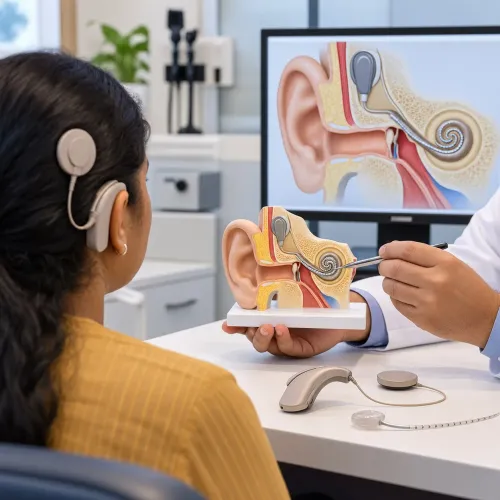
For severe-to-profound loss with limited benefit after appropriate fitting and testing, an ENT and audiology team can discuss cochlear implants or other treatment after full assessment. An implant is not a routine answer for ordinary noisy conversations.
Frequently asked questions
What should I do before choosing hearing aids for noisy conversations?
Start with an ENT or audiologist assessment, including an ear-canal and eardrum examination, hearing thresholds, speech understanding and comparison of both ears.
Which hearing-aid features help in crowded places?
Directional microphones, adaptive noise reduction and speech-focused processing help separate voices from traffic, fans and surrounding chatter.
How can I follow group conversations in busy Nashik settings?
Sit with your back to the wall, face the main speaker, reduce nearby noise and ask people to speak clearly rather than shouting.
How do I test a hearing aid before committing to it?
Test speech understanding in quiet and noisy environments, then assess whether you can follow several speakers without excessive listening effort.
When are hearing aids not enough for difficult conversations?
Further fitting adjustments, assistive listening accessories or additional medical evaluation are needed when speech remains unclear despite correct use and follow-up.